
PRESS RELEASE
With Taxiway M now operational, Mumbai airport is better equipped to handle current demand while creating capacity headroom for future growth, ensuring safer, smoother, and more reliable air travel
Chhatrapati Shivaji Maharaj International Airport (CSMIA), Mumbai, has commissioned Taxiway M, a major airside infrastructure enhancement aimed at improving operational efficiency and resilience at one of the world’s busiest single-runway airports. The new taxiway became operational on December 25, 2025, marking a significant milestone in CSMIA’s ongoing efforts to manage growing air traffic while maintaining safety, punctuality, and sustainability.

CSMIA currently handles over 950 aircraft traffic movements daily, with the bulk of operations relying on the primary Runway 09/27. Until now, these high-intensity movements were largely supported by a single Parallel Taxi Track (N–N1), which remained in near-constant use due to the lack of an alternate full-length taxiway. Over time, sustained traffic volumes and limited maintenance windows underscored the need for an additional parallel taxiway to reduce congestion and dependency on a single route.
From an environmental perspective, shorter taxi distances and reduced ground holding times translate into lower fuel burn and carbon emissions, reinforcing CSMIA’s commitment to sustainable airport operations.
Taxiway M has been developed as a continuous parallel taxiway alongside the main runway, enabling smoother aircraft movement during arrivals and departures. The project, however, came with significant engineering and operational challenges. Its alignment was constrained by the presence of the Aerodrome Rescue and Fire Fighting (ARFF) facility along the corridor. To ensure uninterrupted emergency response capabilities, CSMIA relocated the existing ARFF building, commissioned a temporary main fire station to maintain CAT-10 readiness, and simultaneously initiated construction of a new permanent ARFF facility.
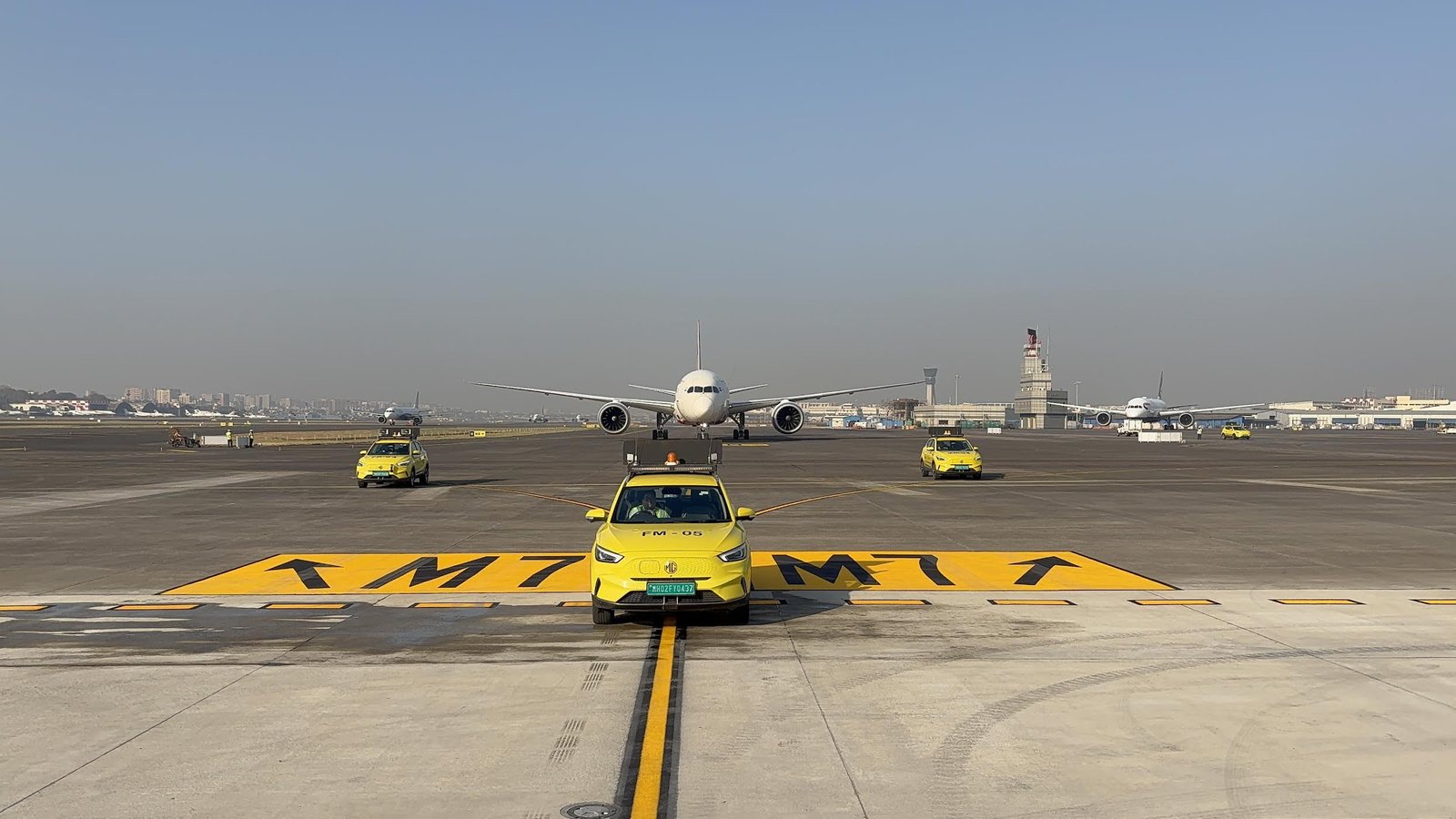
Implemented during the Fourth Control Period (FCP), the project progressed in phases. The initial phase connected Runway 14–32, followed by the creation of a fully continuous parallel taxiway network. Construction was carried out in a highly constrained airside environment, bordered by active taxiways on three sides and a runway on the fourth. Despite these challenges, along with the discovery of uncharted utilities and an early monsoon onset, the project was completed in approximately 240 days through meticulous planning, close stakeholder coordination, and fast-track execution. Timely approvals from the Directorate General of Civil Aviation (DGCA) further ensured adherence to the AIRAC cycle.
Operationally, Taxiway M is expected to significantly reduce aircraft taxi times, improve departure sequencing, and ease congestion during peak hours. Aircraft can now queue efficiently on the taxiway while awaiting take-off clearance, enhancing runway utilisation and airline on-time performance. The new taxiway also provides an alternative routing option during maintenance or unexpected disruptions, strengthening overall operational resilience.