

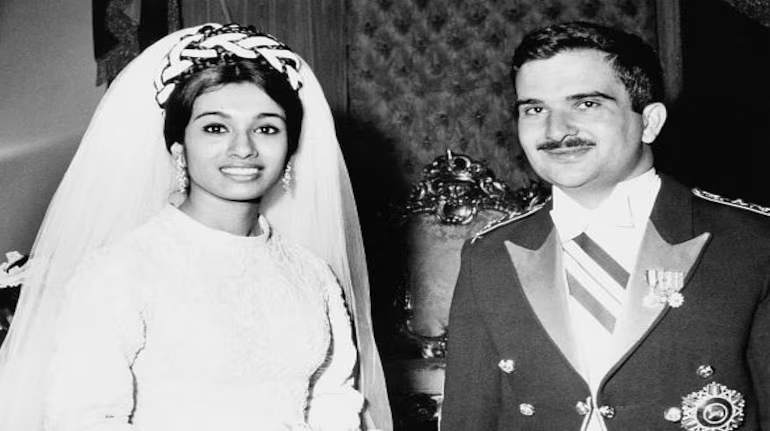
The story of Princess Sarvath El Hassan born in Kolkata, just before Partition
India and Jordan marked a significant diplomatic milestone recently as Prime Minister Narendra Modi concluded his two-day visit to the Hashemite Kingdom, commemorating 75 years of formal relations between the two nations.
It was the first full bilateral visit by an Indian Prime Minister to Jordan in this millennium and came at the invitation of King Abdullah II. While the visit highlighted growing cooperation in politics, trade, and culture, there exists a lesser-known personal connection between the two countries—one rooted in pre-Independence India and embodied in Princess Sarvath El Hassan of Jordan.
Long before she became part of the Jordanian royal family, Princess Sarvath’s story began in Calcutta (now Kolkata), where she was born on July 24, 1947, just weeks before India’s Partition. She was born into the distinguished Suhrawardy family of Bengal, a lineage deeply associated with public service and diplomacy in South Asia.
Her father, Mohammed Ikramullah, was born in Bhopal and served in the Indian Civil Service before later becoming Pakistan’s first Foreign Secretary. Her mother, Begum Shaista Suhrawardy Ikramullah, was a pioneering figure in her own right—one of Pakistan’s first female parliamentarians and later an ambassador to Morocco.
- Princess Sarvath also shares a notable familial connection with India through her paternal uncle, Mohammad Hidayatullah, who served as Chief Justice of India from 1968 to 1970, Vice President of India from 1979 to 1984, and twice as Acting President of India
- This remarkable family background places her at the intersection of South Asian and Middle Eastern history
Raised across several countries due to her parents’ diplomatic assignments, Princess Sarvath received an international education and later studied at the University of Cambridge in the United Kingdom. Her global upbringing prepared her for a life that would bridge cultures and continents.
On August 28, 1968, she married Prince Hassan bin Talal of Jordan in Karachi. At the time, Prince Hassan was the Crown Prince, and Princess Sarvath assumed the role of Crown Princess, becoming one of the most senior women in the Jordanian royal hierarchy. Although King Hussein later named his son Abdullah as successor in 1999, Prince Hassan and Princess Sarvath have continued to play an influential role in royal and international circles.
Known for gracefully acknowledging her Indian heritage, Princess Sarvath has often been seen wearing saris at public events. Together with Prince Hassan, she continues to represent Jordan at global royal gatherings, quietly symbolising a deep, human connection that enriches the modern India–Jordan relationship.
DISCLAIMER: The views and opinions expressed in this article are solely those of the author and do not necessarily reflect the official policy or position of Pravasi Samwad. Pravasi Samwad is not responsible for the accuracy, completeness, or reliability of any information presented.