

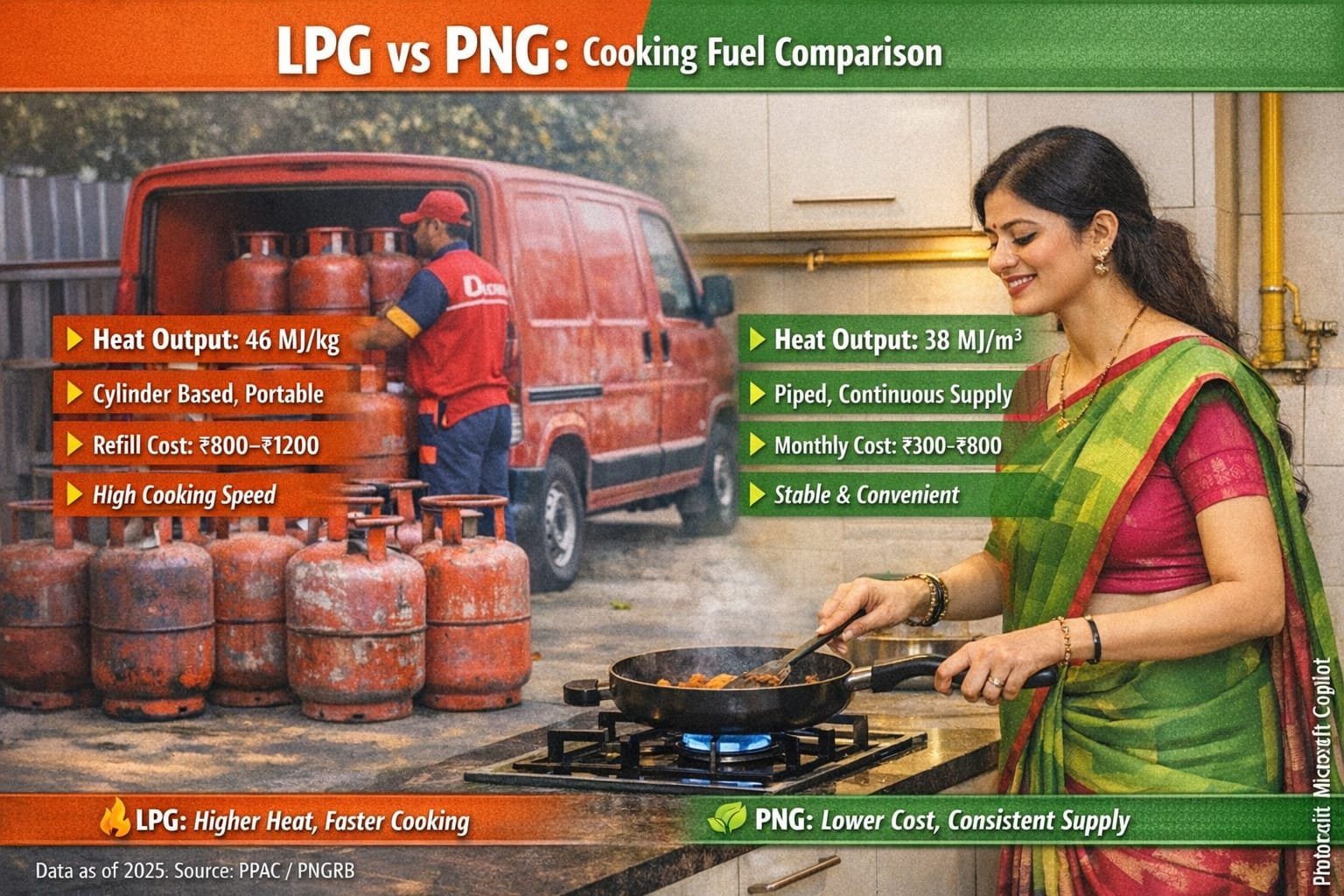
Not many retail energy consumers know the key differences between LPG and PNG cooking gases. Which one should a household choose?
PRAVASISAMWAD.COM
Now is a good time to understand the differences between these two fuels while the world grapples with the disruption in global energy supplies following Iran’s blockade of oil and gas cargo ships in the Strait of Hormuz in the ongoing Persian Gulf War.
Piped Natural Gas (PNG) and Liquefied Petroleum Gas (LPG) are reliable cooking fuels and much cheaper than infrared or induction electrical cooktops and ovens.
Their performance differs sharply in heat output, convenience, cost, and safety. Understanding these contrasts helps households choose the fuel that best fits their cooking process and budget.
As the comparison below shows, LPG edges ahead in overall cooking performance, because of its higher heat output and flexibility, despite the inconvenience of ordering monthly cylinder refills.
Fuel Basics
Energy companies like Gujarat Gas, Indian Oil-Adani Gas, Indraprastha Gas, and Godavari Gas deliver PNG through underground pipelines network in cities. This fuel comprises 85–95% methane. It gives consistent quality and steady pressure.
Indian Government companies like HP Gas, Bharat Gas and Indane, and private companies like Reliance, Super Gas, Total Gas, Go Gas and Essar deliver LPG in portable, but heavy cylinders with varying propane–butane mixes. These compositional differences shape how each fuel behaves in the kitchen.
Unofficial data peg LPG users in India to 32.97 crores (329.7 million) as on April 2025.
Heat Output and Efficiency
LPG clearly wins here. LPG delivers 46 MJ/kg, producing faster boiling and quicker cooking, especially for high‑heat tasks like searing and stir‑frying. Professional chefs and community kitchens prefer LPG for its intensity and flame precision.
PNG, at 38 MJ/m³, offers steady, even heat – ideal for simmering and slow cooking. Its consistency benefits delicate dishes, but cannot match LPG’s speed.
Cost Considerations
PNG generally costs less per unit of energy and suits high‑usage households. Subscription and installation fees range from INR 2,000–5,000, with monthly bills average between INR 300 to 800 for a family of four.
LPG requires cylinder deposits and higher refill costs (INR 800–1,200), though it avoids fixed monthly charges. However, its inconvenient because of the hassle of ordering refill and awaiting cylinder delivery.
Data show urban households in Gujarat and Maharashtra prefer PNG while smaller towns and rural places have to perforce use LPG because of no PNG network.
PNG connection wins on convenience. Small wonder Maharashtra has 40.2 lakh, Gujarat (35.93L), Uttar Pradesh (16.50L) and Delhi (15.64L) and Haryana (3.96L) users as on 2025.
The data above come from Petroleum Planning and Analysis Cell (PPAC) and Petroleum and Natural Gas Regulatory Board (PNGRB), the only authoritative state‑wise PNG connection sources available for 2025.
Maharashtra and Gujarat states dominate due to early CGD rollout, strong demand urban working class families, and mature gas distribution networks, these official bodies say.
Uttar Pradesh and Delhi follow because of rapid CGD expansion under PNGRB’s 9th–11th bidding rounds. Haryana ranks fifth with steady, but slower PNG penetration.
Safety and Handling
Both fuels are safe when used correctly, but their systems differ. LPG cylinders include safety valves and can be disconnected quickly during emergencies.
PNG systems rely on built‑in leak detection, pressure regulation, and external shut‑off valves. PNG eliminates cylinder‑related risks, while LPG requires careful storage and periodic tube checks.
Environmental Impact
PNG produces lower carbon emissions and has zero transport pollution, unlike LPG cylinders delivered at home by vehicles running on diesel. LPG burns cleanly, but has a slightly higher carbon footprint due to cylinder logistics. Both fuels maintain good indoor air quality when stoves are properly adjusted.
Convenience and Reliability
PNG offers unmatched convenience with uninterrupted supply, no cylinder handling, and predictable billing. LPG provides portability, backup flexibility, and independence from utility networks — useful in remote or temporary setups.
Installation and Maintenance
PNG requires professional installation and annual inspections. LPG setup is quick and user‑managed, with occasional regulator and tube replacements.
Conclusion
LPG emerges as the stronger performer for heat output, speed, and cooking control. PNG excels in convenience, cost stability, and safety infrastructure. The best choice depends on household priorities, but for pure cooking performance, LPG takes the crown.