
Together, the replica serves as a powerful reminder of the enduring cultural and scholarly bonds linking India and Indonesia across centuries
Indonesia has formally received a replica of the historic Nalanda Copperplate Inscription from the Government of India, marking a meaningful milestone in the cultural and historical relationship between the two nations. The replica has been placed at the Muarajambi Museum, located within the Muarajambi National Cultural Heritage Area in Jambi province, a site long associated with Indonesia’s ancient intellectual and spiritual traditions.
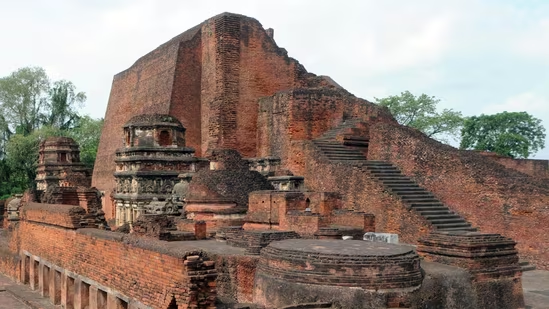
Indonesia’s Minister of Culture, Fadli Zon, described the handover as an important contribution to strengthening the country’s historical narrative. According to him, the inscription provides tangible evidence of Muarajambi’s role as a prominent center of learning and its deep connections with global centers of knowledge in the past. He emphasized that the artifact highlights links between Muarajambi, Nalanda University in India, the Srivijaya Kingdom, the Syailendra Dynasty, and India’s Pala Dynasty, underscoring a shared civilizational heritage that dates back more than a millennium.
-
The replica was officially handed over on the sidelines of the UNESCO Intergovernmental Committee for the Safeguarding of the Intangible Cultural Heritage session in New Delhi on December 9, 2025
-
This followed sustained cultural diplomacy efforts by Indonesia’s Ministry of Culture, including high-level bilateral discussions held during President Prabowo Subianto’s state visit to India earlier in the year
Director General of Cultural Diplomacy, Promotion and Cooperation Endah T.D. Retnoastuti noted that the replica symbolizes more than a reproduction of an ancient artifact. It reflects a joint commitment by Indonesia and India to protect, preserve, and revitalize a shared historical legacy rooted in centuries of intellectual, religious, and cultural exchange. She added that the initiative supports Indonesia’s ongoing efforts to strengthen Muarajambi’s standing on UNESCO’s Tentative List of World Heritage Sites, which was updated in 2025, as part of preparations for a future formal nomination.
Indian Ambassador to Indonesia Sandeep Chakravorty explained that the original Nalanda Copperplate Inscription dates back to 860 CE. Written in Sanskrit using the Devanagari script, it records a land grant made by King Devapaladeva of the Pala Dynasty at the request of King Balaputradewa of Suwarnadwipa. The inscription details provisions for maintaining a stupa and supporting monks from the Indonesian archipelago who studied and translated manuscripts at Nalanda, highlighting the long-standing academic exchanges between the two regions.