
Pravasi Samwad New Delhi Bureau
This latest advisory reflects India’s efforts to ensure the safety of its citizens abroad amid heightened geopolitical tensions, and follows similar warnings issued for other parts of the region recently
In response to a fresh escalation in the Middle East, the Indian Embassy in Tel Aviv has issued a safety advisory for Indian nationals in Israel. The move comes after recent military actions in the region involving Israel and the United States, which have unsettled the already volatile security environment.
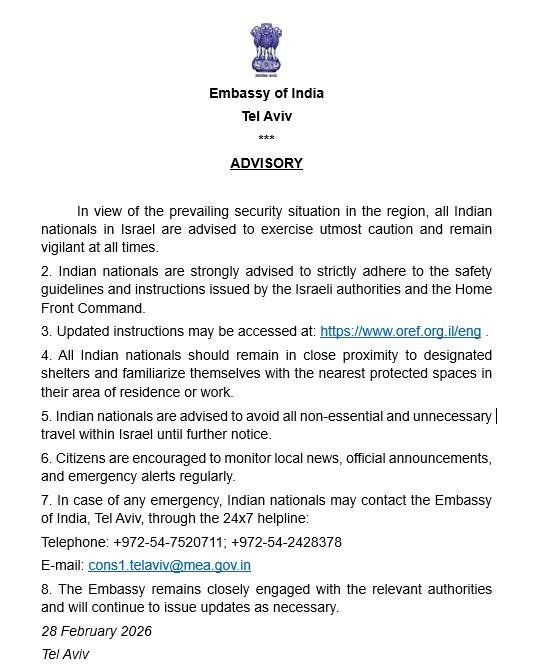
The advisory calls on all Indian citizens in Israel to exercise utmost caution and remain vigilant at all times. It stresses the importance of following directions from Israeli authorities and the Home Front Command, which is responsible for civilian safety and emergency alerts.
Indian nationals are urged to stay close to designated shelters and to familiarise themselves with the nearest protected spaces, whether at home, work or elsewhere. This step is advised because of ongoing uncertainties and the possibility of sudden alerts or warnings.
The embassy also recommends that people avoid all non-essential travel within Israel until the situation stabilises. Citizens are encouraged to keep up with local news, official announcements and emergency alerts so they can react quickly to any changes.
For help in an emergency, the Indian mission has activated a 24-hour helpline and provided contact details for nationals who need assistance or more information. The embassy has stated that it is in close contact with relevant local authorities and will keep issuing updates as required.
Meanwhile, media reports said the United States and Israel have launched military strikes on Iran, sharply escalating tensions in the Middle East. Explosions were reported across the Iranian capital, Tehran, with witnesses describing loud blasts and heavy smoke rising from different parts of the city.
According to Iranian media, several missiles hit areas around University Street and the Jomhouri district in central Tehran. Emergency services were seen moving towards the affected sites as thick plumes of smoke filled the skyline. Local residents reported scenes of panic as sirens sounded across the city.
An on-ground correspondent from Al Jazeera said multiple explosions were heard and seen, confirming visible damage in parts of the capital. Iranian news agency Fars also reported direct strikes on key urban areas.
Soon after the attacks, apparent retaliatory explosions were reported in northern Israel, raising fears of a wider conflict. The situation remains tense, with both sides appearing to exchange fire.
The impact of the strikes was not limited to Iran and Israel. Blasts were also heard in several Gulf cities, including Doha, Abu Dhabi, Dubai, and Riyadh. While the exact cause of these explosions is still unclear, reports suggest heightened military activity and air defence responses across the region.
Governments in the Gulf are closely monitoring developments, and airspace in some areas has reportedly faced temporary disruptions. The full scale of damage and casualties has not yet been confirmed.
The latest events mark a serious escalation in an already fragile region, with global leaders likely to call for restraint to prevent further widening of the conflict.