
July 27, 2026
Maharashtra’s most sensuous, percussion beats and rhythm‑driven folk dance called Lavani has gyrated on diverse stages. Between the 1950s and late 70s, it was the beating heart of Tamasha — a travelling folk theatre tradition. Its routine comprised a lead female dancer, often backed by supporting dancers, a queer comic sidekick, a harmonium and dholak (dholki) players. The troupe’s template included songs, dance, music, erotic humour, teasing, satire, and social commentary. Travelling troupes performed everywhere — from village tents to community halls across the state.
Tamasha troupes travelled from village to village, performing through the night, drawing entertainment-starved crowds of farmers, labourers, and small‑town audiences.
The art form thrived on live stage performers. The titillating gyrations of dancers, in green nauvari (nine yards or 8.25 meters) sarees, the jingling of ghungroos (metal ankle bells) to dholak beats, the flirtatious repartee between dancers and musicians, and the earthy humour drawn from workers’ daily lives ensured men arrived in hordes.
Lavani was not merely entertainment; it was a social event, a setting for poor male workers to release their pent-up frustrations. Lavani performers held a mirror to rural Maharashtra in the mid 20th century.
Time rattles Lavani stage
The decline of traditional Tamasha troupes is one of Lavani’s most significant transformations.
The hereditary communities that continued the art — Kolhati, Mahar, Matang — have faced decreasing patronage, because of urban migration, persistent caste stigma and competition from other arts.
The touring economy that kept Lavani alive began to collapse as rural audiences migrated to cinema, television, and later digital entertainment.
Baithakichi Lavani, the intimate, seated form once patronised by Maratha rulers and royals vanished. Phadachi Lavani (stage) resisted obsolescence. The grand, theatrical Sangeet Bari style survives, but mostly through curated performances rather than community patronage.
Yet Lavani’s symbolic value has grown. Lavani is now cultural heritage rather than rural titillation. Government‑supported festivals, Maharashtra Mandal events in metro cities, and folk‑arts showcases in Delhi and Pune have repositioned Lavani as a prestigious performance tradition.
Doordarshan showcases Lavani
People over 60 recall watching Lavani and other cultural programmes on Bombay (now Mumbai) Doordarshan. Maharashtra state government did well to promote folk arts.
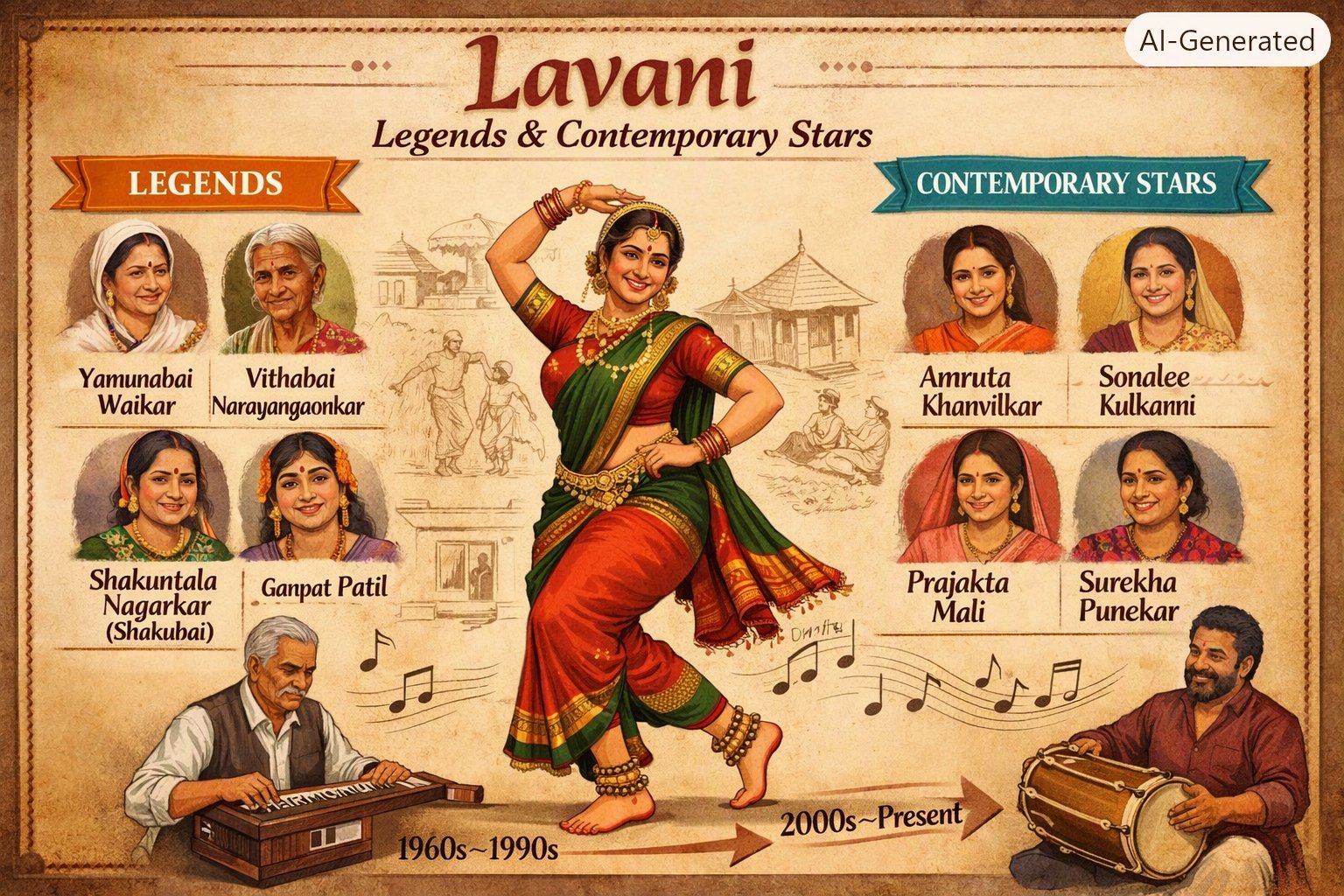
Doordarshan often broadcast Lavani episodes in the 1970s. The episodes featured leading female Lavani dancers with chorus girls, musicians and the constant comic sidekick, often played by actor Ganpat Patil — celebrated for his Nachya roles. For many families, these black‑and‑white telecasts were their first glimpse of Lavani —a world that was rural, vibrant, and the content unapologetically raunchy.
Bombay’s only television channel regularly aired Lavani episodes featuring marquee Tamasha troupes, such as Shakuntala Nagarkar (Shakubai), Mangala Bansode, Yamunabai Waikar, and members of Vithabai Narayangaonkar’s ensemble.
These artistes were active in state‑sponsored cultural programmes and well‑documented collaborators of comic actor Ganpat Patil in live Tamasha performances. However, the state broadcaster’s archival records from the 1970s are not extensive. Unfortunately, Doordarsan aired many folk‑arts episodes only once.
—
Cross‑dressing, humour, and the 1970s audience
Ganpat Patil’s cross‑dressing, effeminate gait, and camp humour were central to his Nachya persona — a traditional role in Tamasha where a male performer plays a coquettish female character. His performances often carried subtle queer overtones, though within folk‑theatre conventions rather than identity politics.
This act surprisingly did not provoke moral outrage in the 1970s. Maharashtra’s self-appointed cultural watchdogs and moral police had yet not emerged to flex their self-righteousness and judgmental terrorism on art and artistes. Rural and some urban audiences embraced the humour, mimicry, and gender play as part of Tamasha’s charm.
Urban middle‑class families reacted differently. I recall my father, a doctor and professor at Bombay Veterinary College, Parel, mildly disapproving Ganpat Patil’s effeminate mannerisms and playful dialogues — responding like a typical moralistic Maharashtrian middle‑class man during conversations at home. “Hya mansala kahi laaz vatat nahi ka?” (Is this man not ashamed? He would ask. His discomfort reflected a broader cultural hesitation among urban elites, who viewed Lavani and Tamasha as earthy, risqué, and socially inferior forms of entertainment.
Why the urban elite loathed Lavani?
Lavani’s fraught relationship with the Maharashtrian urban elite finds roots in class, caste, and morality.
For decades, middle‑class audiences dismissed Lavani as vulgar, associating it with sexual innuendo, flirtatious lyrics, and voyeuristic male gaze. The erotic elements of Lavani — hip gyrations, heaving of breasts and swinging buttocks, suggestive gestures, and double‑meaning verses — clashed with urban notions of “respectable culture.”
The censure and contempt were not merely moral. Blame caste codes. Lavani emerged from communities historically marginalised and excluded from mainstream cultural institutions.
Urban elites preferred classical forms like Bharatanatyam and Kathak, which carried Brahminical prestige. Lavani, by contrast, was seen as rural, bawdy, and socially inferior.
The digital renaissance
Lavani enjoys high visibility in the 21st century. The 1970s performers did not get this benefit. YouTube, Instagram reels, and reality shows have become popular and powerful platforms for Lavani performers.
Artistes like Amruta Khanvilkar, Sonalee Kulkarni, Prajakta Mali, Surekha Punekar, and Megha Ghadge have leveraged modern media to cultivate national audiences. Their performances — polished, choreographed, and visually glamorous — circulate far beyond Maharashtra and India’s borders.
This digital shift has upgraded Lavani’s aesthetics. Camera‑friendly choreography, better song and content compositions, and stylised costumes have replaced the raw, improvisational energy of Tamasha. Contemporary performers enjoy high technology audio, video, professional lighting, makeup, stage design, and media publicity — luxuries that earlier generations never had.
Curated festivals: legitimacy and safety
Curated festivals have done more than revive Lavani — they have legitimised it and burnt social stigma. By placing Lavani alongside classical and folk arts, festivals have reframed the form as cultural heritage rather than erotic and coarse spectacle. This shift has given present-day artistes financial stability, safer working conditions, social respect and fan adulation.
Surekha Punekar rose from traditional Tamasha circuits to mainstream recognition through televised appearances. Megha Ghadge’s stage productions blend traditional Lavani with contemporary choreography, attracting younger audiences. Amruta Khanvilkar’s film performances have brought Lavani back into Marathi cinema’s mainstream consciousness.
Lavani today: fragile but alive
Lavani is not dying. It is evolving. Its traditional setup — hereditary troupes, rural patronage, and Tamasha circuits — is fragile. In contrast contemporary media — digital media, cinema, curated festivals, and academic interest — is vibrant.
The art form has survived centuries of social change. I guess, Lavani will survive the 21st century too — transformed, reframed, but still beating with the same dholki pulse.